

Last Updated: 10/10/2026
How to Calculate Dental Office Overhead (Simplified Method)
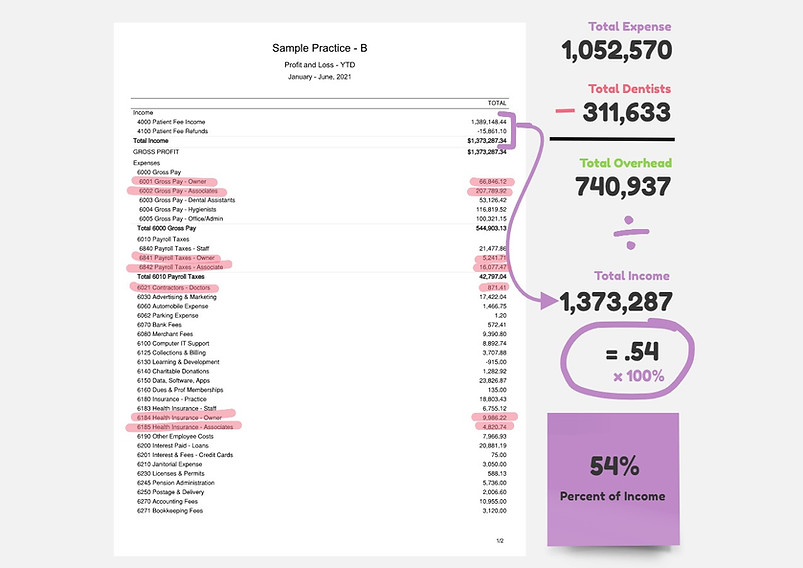
This post shows the three steps to calculate your dental practice overhead percentage from a Profit & Loss report. Cross out owner and associate pay, total the remaining expenses, and divide by collected revenue. The current averages to compare against are on the 2026 Dental Practice Overhead Percentages page: 62.2% for general practices, owner and associate pay excluded.
.jpg)
Get Your Profit & Loss
You will need an updated Profit & Loss report to complete these steps. You can print one from QuickBooks Online, but if you aren't updating your bookkeeping, confirm with your bookkeeper that the bookkeeping is complete through the report date.
I suggest using a full 12 months. If you calculate overhead using only a few months of data, it likely won't match our 12-month averages because you're missing seasonal fluctuations across a full year.
Step One: Cross out expenses related to all dentists
Exclude compensation and related expenses for dentists, including the owner, the owner’s family, and associates. Put your Profit & Loss report in front of you, and put a line through the following expense accounts:
-
Gross Pay - Owner / Partners
-
Gross Pay - Associates
-
Gross Pay - Family members of owner
-
Employer Payroll Taxes - Owner / Partners
-
Employer Payroll Taxes - Associates
-
Employer Payroll Taxes - Family members of owner
-
Contractors - Doctors/Associates
-
Health Insurance - Owner / Partners
-
Health Insurance - Associates
-
Health Insurance - Family members of owner
-
Disability Insurance - Owner / Partners
-
Life Insurance - Owner / Partners
-
Pension Matching - Owner / Partners
-
Pension Matching - Associates
Note: If you don't have some of these expenses separated on your Profit & Loss report, you will need to find the costs and pull them out of the expense accounts they are in. However, to stay on top of your overhead averages consistently, I recommend creating separate expense accounts for the items above in your Dental Chart of Accounts.

Step Two: Add together the remaining expense accounts
Add up all of the remaining expense accounts (excluding the dentists' expenses from step one) on your Profit & Loss report.
This can be more easily done by just adding together the 'Total Expenses' and 'Total Other Expenses' summed at the bottom of your Profit & Loss report. Then, subtract from the total expenses all of the dentists' expenses you crossed out in step one above.

Step Three: Calculate Percent of Income
Divide the total overhead expenses from step two by your total collection income (collected revenue after patient refunds), as stated at the top of your Profit & Loss report. Then multiply that number by 100. Now you have an overhead percentage you can compare to industry averages.
The 2026 averages are on the Dental Practice Overhead Percentages page: 62.2% for general practices, owner and associate pay excluded.
What's Next:
Now that you know your total dental practice overhead, you can keep benchmarking against the dental industry average as you improve your practice. I recommend benchmarking your overhead every month.
The idea is that you want your overhead to stay the same or go down as your collection income increases. If you're increasing your collections but your percent of practice overhead is going up, you're not keeping as much of what you earn. That's not good.
Regardless of how you're doing, practice reviewing the numbers and understanding why those numbers happen by connecting the numbers to your physical operations. Once you understand the connections, you get better at predicting the outcomes of business decisions you make.
Advanced Overhead Benchmarking:
Once you're comfortable calculating overhead month to month, break down the percentage into the five categories on the 2026 Dental Practice Overhead Percentages page. Then you can compare each category and see where the practice stands.

Sona Wegner is the owner of Percentology. She has an accounting degree and an MBA, started at a dental CPA firm in 2007, and has worked with dental practices since. She started Percentology in 2013. The averages above come from general practices for which her team maintains bookkeeping.